
Security
Cargo theft prevention for the 2026 holidays: a plan for small fleets
November 24, 2026


Fewer thefts, bigger losses: the 2026 holiday risk dates, an office checklist for fake pickups and hijacked carrier IDs, and who to call first.
By Alex Smith
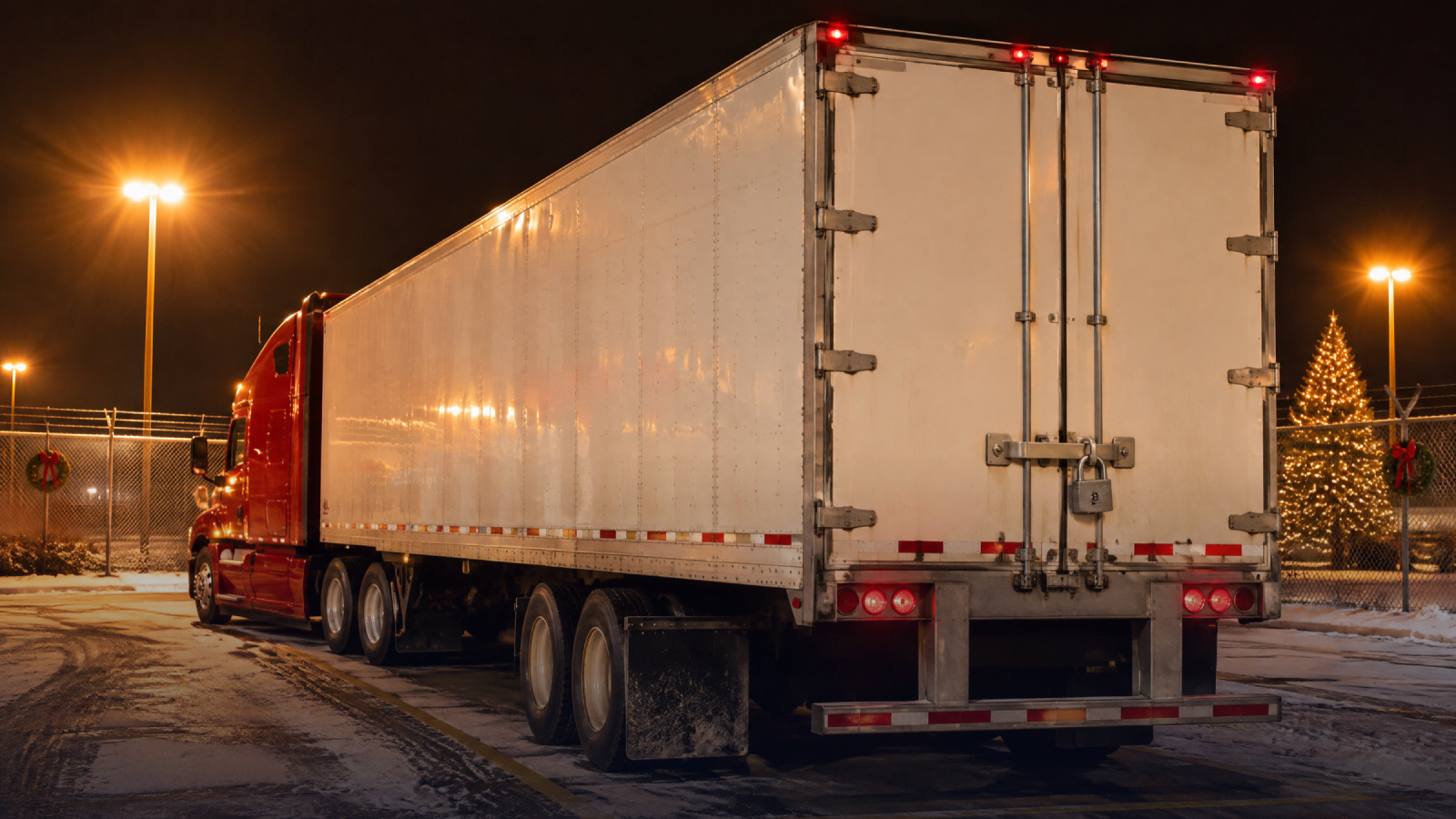
Cargo theft prevention over the 2026 holidays comes down to three habits. Never let a loaded trailer sit unwatched over a long weekend, confirm every pickup and broker through a second channel, and know who to call in the first hour. Theft data firms warn that thefts usually rise from Thanksgiving into the new year.
As of November 19, 2026: the numbers below come from Verisk CargoNet's third-quarter report (November 4) and Overhaul's third-quarter report (November 16). Holiday-period numbers for 2026 aren't out yet.
What changed in 2026: fewer thefts, bigger losses
Reported thefts are down, but each one costs more, and more of them start with a lie instead of a bolt cutter. Several top-ranking guides still say incidents are "on the rise" using 2023–2024 numbers.
| What the data shows | Number | Source |
|---|---|---|
| Thefts in the third quarter (Q3) of 2026, U.S. and Canada | 547, down 33% from Q3 2025 | Verisk CargoNet |
| Losses, January to September 2026 | $718.9 million, up 39% | Verisk CargoNet |
| Average stolen value per theft, 2026 so far | $448,456, up from $261,115 | Verisk CargoNet |
| Share of thefts that were fictitious pickups | about 25%, up from 18% | Verisk CargoNet |
| Share of U.S. thefts at truck stops and fuel stations, Q3 | 20.7%, up from 7.3% | Overhaul |
| Riskiest day and hours, Q3 | Friday (20.5%); noon to 6 p.m. (32%) | Overhaul |
A fictitious pickup is a theft where someone poses as the real carrier or driver and is handed the load. California, Illinois, New Jersey and Texas made up 57% of CargoNet's third-quarter cases. Overhaul found the I-20 corridor in southern Dallas alone accounted for 82.1% of U.S. truck stop and fuel station thefts.
The 2026 holiday calendar: when your loads sit
CargoNet says theft "typically intensifies in Q4 and reaches peak levels in December" in its Thanksgiving 2025 alert. The same alert counted 79 thefts in the 2024 Thanksgiving period, up from 48 the year before. This year Christmas and New Year's Day both fall on a Friday, the riskiest day in Overhaul's data.
| Holiday | Date | Why it matters |
|---|---|---|
| Thanksgiving | Thursday, Nov 26 | A receiver closed Thursday and Friday leaves a Wednesday pickup sitting up to 4 days |
| Christmas | Friday, Dec 25 | Three-day weekend; early closing on Christmas Eve makes it longer |
| New Year's Day | Friday, Jan 1, 2027 | Second three-day weekend in a row |
Ask brokers about receiver hours before you book, not after you load.
How loads get stolen now
| Method | How it works | First defense |
|---|---|---|
| Pilferage at a stop | Thieves open a parked trailer and take part of the load; 82.1% of truck stop thefts in Overhaul's Q3 data | Staffed, fenced parking; a high-security lock; a driver nearby |
| Whole trailer or tractor | A loaded trailer left in a drop lot or on a street over a holiday is hooked and driven off | Keep it hooked to the tractor; kingpin and glad-hand locks |
| Fictitious pickup | Someone shows up as your driver, or books the load as your company | Pickup codes; check the name and USDOT number on the truck |
| Hijacked carrier identity | Criminals take over a carrier's email or load board account, then book real loads in its name | Protect email logins; check your own federal registration record weekly |
The last row is the one many small carriers miss. A Federal Bureau of Investigation (FBI) public service announcement from April 30, 2026, describes thieves who change a hijacked carrier's contact details with the Federal Motor Carrier Safety Administration (FMCSA). The carrier may learn of it only when brokers call about loads it never booked.
Before dispatch: the office checklist
Run this for every holiday load and every new broker:
- Check your own record. Open your company snapshot on SAFER, FMCSA's public carrier lookup, and confirm your phone number is correct. FMCSA tells carriers to do exactly this.
- Call the broker back on the SAFER number. If the phone in the email doesn't match SAFER, FMCSA says to use the SAFER number.
- Read the sender's address. The FBI warns about free email accounts that copy a real company name, shortened links, and "bad review" emails with links.
- Walk away from these four. FMCSA says to stop if you're asked to use another carrier's name, or if you ask where the load goes and hear "blind load" instead. The same goes for a broker who agrees too fast to pay more, or a rate far above market.
- Ask about the receiver. Get its holiday hours in writing. If the load would sit over the weekend, settle where before you accept it.
- Send photos. Photograph the seal, the loaded trailer, the bill of lading and the plates at pickup.
At pickup, the shipper will look at your truck. Federal rules in 49 CFR 390.21 require the carrier's name and "USDOT" number on both sides, readable from 50 feet. Make sure yours are clean and readable before the holidays.
On the road and parked: rules for drivers
- Eat and fuel before you load. The National Insurance Crime Bureau warns that thieves often wait outside shipping sites for drivers to stop.
- Pick the stop by risk, not habit. Truck stops and fuel stations are now a top target, and the afternoon is the busiest theft window.
- Don't leave a loaded trailer alone. If you must step away, keep it in sight and locked.
- Check in on a schedule. A missed check-in should start a call, not a guess.
- Never tell anyone the load, route or delivery. That includes a friendly stranger and a "new dispatcher" on a number you don't know.
If moving to safer parking uses driving time, check the hours-of-service limits first. Winter delays may also qualify for the adverse driving conditions exception.
Worked example: a Christmas-weekend delivery
An owner-operator books a dry van of beverages from Ontario, California, to Phoenix, about 330 miles. Pickup is Thursday, December 24, at 9:00 a.m. Food and beverage loads were the top target in CargoNet's Q3 data.
The receiver closes at noon that day and reopens Monday, December 28, at 8:00 a.m. The driver can't make the noon cutoff. Arriving around 4:00 p.m. Thursday, the load would sit 88 hours before unloading.
| Choice | What happens | Verdict |
|---|---|---|
| Park at a big truck stop near the receiver | 88 hours in the location type with the fastest-growing theft share; driver leaves for the holiday | No |
| Drop the trailer outside the receiver's gate | Unhooked, unwatched trailer from Thursday to Monday | No |
| Before booking, ask the broker to move pickup or find a staffed yard | Load sits in a fenced, staffed lot, still hooked, with locks and a photographed seal | Yes |
The owner made the call when the load was offered, not on Thursday afternoon. The weekend off also counts as a 34-hour restart of the 60/70-hour clock under 49 CFR 395.3(c).
If a load is stolen: the first hour
- Call 911 or local police. Get the report number; everyone after this will ask for it.
- Call the broker or shipper on a number you already trust, not one from the latest email.
- Pull the truck's location history and the last time it reported. Send it to police with your photos.
- Call your insurer and send the report number.
- If it was fraud or a hacked account, file at ic3.gov. Then call the FMCSA Contact Center at 1-800-832-5660 and file in the FMCSA Complaint Center.
- Tell your load boards and factoring company if your company's name was used.
If your trucks run Motion Fleet (Motion ELD), the office can see each truck's location, power status and movement history in GPS Tracking. It can also open Live Video from the truck's cameras. That history is what step 3 needs.
If you hauled a fraudulently brokered load, don't keep it to force payment. FMCSA's fraud page says "holding loads hostage until you get paid is illegal" and tells carriers to contact whoever is paying the freight.
FAQ
Is cargo theft a federal crime?
Yes, when the goods are moving in interstate or foreign commerce. Under 18 U.S.C. 659, stealing from an interstate shipment can bring a fine and up to 10 years in prison, or up to 3 years when the value is under $1,000. States can also prosecute. Local police take the first report.
What is a fictitious pickup?
It's a theft by deception. Someone poses as the assigned carrier or driver, shows convincing paperwork, and the shipper hands over the load. Verisk CargoNet counted 138 fictitious pickups in the third quarter of 2026, about one in four reported thefts. Pickup codes and a check of the truck's USDOT number are the cheapest defenses.
When does cargo theft peak during the holidays?
Verisk CargoNet says theft usually rises in the fourth quarter, peaks in December and stays high into the new year. Long weekends are the risk, because receivers close and loads sit. In 2026, Christmas and New Year's Day both fall on a Friday, which gives two three-day weekends back to back.
What cargo do thieves target most?
In the third quarter of 2026, CargoNet's top category was food and beverage with 94 thefts, followed by metals with 63, including 34 copper loads. Household goods and electronics followed. Overhaul's data put electronics first at 23.3% of U.S. thefts. If you haul any of these, treat holiday weekends as high risk.
Can I hold a load until the broker pays me?
No. FMCSA's fraud guidance states that holding loads hostage until you get paid is illegal. If you hauled a load that was brokered by a fraudster, find out who is paying the freight and ask to reach their broker. In many cases the real broker was also a victim.
Updated: November 19, 2026
Sources
- Verisk CargoNet, "Fewer Cargo Thefts, Bigger Losses," November 4, 2026: https://www.cargonet.com/news-and-events/cargonet-in-the-media/2026-q3-theft-trends/ (checked 2026-11-19)
- Verisk, "Verisk CargoNet Issues Alert: Cargo Theft Risks Spike During Thanksgiving Holiday," November 25, 2025: https://www.verisk.com/company/newsroom/verisk-cargonet-issues-alert-cargo-theft-risks-spike-during-thanksgiving-holiday/ (checked 2026-11-19)
- Overhaul, U.S. Q3-2026 Cargo Theft Report release, November 16, 2026: https://www.prnewswire.com/news-releases/cargo-thefts-at-us-truck-stops-nearly-tripled-in-q3-overhaul-report-finds-302939261.html (checked 2026-11-19)
- FBI Internet Crime Complaint Center, PSA "Cyber-Enabled Strategic Cargo Theft Surging," April 30, 2026: https://www.ic3.gov/PSA/2026/PSA260430 (checked 2026-11-19)
- FMCSA, "Broker and Carrier Fraud and Identity Theft" (last updated April 7, 2025): https://www.fmcsa.dot.gov/mission/help/broker-and-carrier-fraud-and-identity-theft (checked 2026-11-19)
- FMCSA Complaint Center: https://nccdb.fmcsa.dot.gov/ (checked 2026-11-19)
- 49 CFR 390.21, Marking of self-propelled CMVs: https://www.ecfr.gov/current/title-49/subtitle-B/chapter-III/subchapter-B/part-390/subpart-B/section-390.21 (eCFR current to 2026-11-17)
- 49 CFR 395.3, Maximum driving time: https://www.ecfr.gov/current/title-49/subtitle-B/chapter-III/subchapter-B/part-395/section-395.3 (checked 2026-11-19)
- National Insurance Crime Bureau, Cargo Theft: https://www.nicb.org/prevent-fraud-theft/cargo-theft (search excerpt read 2026-11-19; page blocks scripts)
- 18 U.S.C. 659 (LII copy of the U.S. Code): https://www.law.cornell.edu/uscode/text/18/659 (checked 2026-11-19)
Questions about tracking or cameras for your trucks? Talk to the Motion Fleet team.
What's next
DOT
November 21, 2026
Truck chain laws by state: winter 2026–27 rules, fines and what fleets should do
Where trucks must carry chains vs mount them in CO, WA, CA, OR, NV and WY, the fines, and why a forecast storm won't earn extra driving hours.
IFTA
November 18, 2026
How to calculate IFTA miles and tax by state (with a worked example)
The IFTA formula with the return's rounding rules, one truck's quarter worked through with credits and a surcharge, and the trip records auditors accept.
ELD
November 17, 2026
ELD Violations and Fines: 2026 Penalties and CSA Points
The common ELD violations, their CSA severity weights, 2026 fines up to $15,846, and how long one inspection stays on your record. With an owner checklist.